

Service marks 50th anniversary of Strabane man’s murder
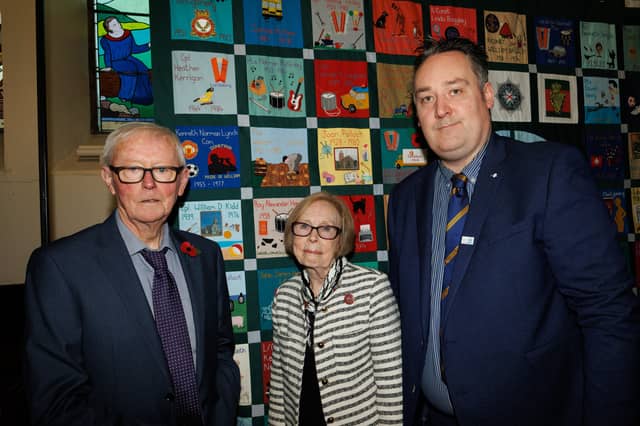

A poignant Service of Remembrance, Thanksgiving and Hope was held in Christ Church, Strabane, to mark the 50th anniversary of Corporal Derek Kidd's murder, with Kenny Donaldson, director of the Troubles victims' charity, SEFF, paying tribute to the 'committed and courageous' soldier who was 'a good husband and devoted father'.
A SPECIAL anniversary service has been held to mark the 50th anniversary of the murder of a Strabane man.
Corporal Derek Kidd, from Glen Road, was aged 37 when he was shot dead by the Provisional IRA on November 18, 1976.
The married father-of-three was a part-time UDR soldier.
At around 2.30pm he was working on a building site in the Trench Road of the Waterside area of Londonderry when two gunmen shot him at close range.
Mr Kidd's wife issued a statement pleading for no retaliation for her husband's murder.
On Sunday, a poignant Service of Remembrance, Thanksgiving and Hope was held in Christ Church, Bowling Green, Strabane.
Addresses were given at the service by Rev Wray and Rev Rhys Jones, with Mr Kidd's UDR CGC colleague, Derick Donnell and Derek’s nephew, Paul Kidd, also shared reflection.
Several members of the Kidd family participated in the service, alongside friends and others from across the community.
Speaking at the service, Kenny Donaldson, director of the Troubles victims’ charity, SEFF, extended thanks to everyone who participated and helped make the service a special occasion.
“He was a committed and courageous UDR CGC soldier and was very much respected by his colleagues but he was much more than this; he also held down other employment as we have heard, but crucially he was a good husband and devoted father and was firmly rooted in this local community, and was respected by people from all backgrounds,” Mr Donaldson said.
“It has been a truly collaborative effort, and we are indebted to all involved who have ensured the occasion was both intimate and special.
“Derek’s murder was met with shock and revulsion by many people who had the privilege of knowing him.
“Derek may have been viewed as quite ordinary to those without connection to him, but for those who knew him best; he was in fact quite an extraordinary human being.
“Derek Kidd didn’t join the UDR CGC so that he could throw his weight around, demean his neighbour or project sectarian hatred.
“He joined because he was concerned of the risks posed by terrorism within this society, he cared deeply about this community - all of it - and felt compelled to act - to stand in the gap and defend the principles of democracy of freedom for all people.
“He also wanted to be a provider for his family and at time when finance was scarce, this was also a motivation for him.”
Mr Donaldson also reflected on 1976 and the intensity of the violence people were required to live through.
1976, he said, was “the second worst year of ‘The Troubles’, behind 1972 in terms of the numbers of people murdered/killed” with 297 people losing their lives.
“1976 was a very bleak and dark year, many who lived through it would suggest that the period of mid-August 1975 to end March 1976 was the closest Northern Ireland came to all out civil war,” Mr Donaldson continued.
“The narrative of 1976 was set in the first week by the sectarian motivated murders of the Reaveys, the O’Dowd’s and the Kingsmills attack - 16 innocents murdered for reasons of sectarian and ethnic motivated hatred.
“1976 also saw the murder of British ambassador to the Republic of Ireland, Sir Christopher Ewart Biggs and a young civil servant, Judith Cooke.
“But the year also brought a semblance of hope through the formation of The Peace People Movement when women from across the community came together in the aftermath of the tragic deaths of the Maguire children.
“They came together to make a stand against violence and dared to speak words of peace when this place was in absolute turmoil.
“Peace or even a cessation in violence would’ve seemed beyond possible.
“It is those special women, Mairead Corrigan-Maguire (the children’s aunt), Betty McWilliams and so many other special women and men across this society, including the Kidd family, whose restraint, their will to work for something better and their personal grace which ultimately won through.
“But not before approximately 2,000 more people were murdered/killed and tens of thousands injured, physically and psychologically.
“For those who naively peddle the line that its 50 years ago and remembrance merely stokes up hatred and feeds the flames of division; they simply don’t get it.
“Communal remembrance and a willingness to call out all terror and other criminal violence, whether perpetrated by terrorists or those attached to States, actually provides the blueprint for building genuine conciliation, leading to reconciliation.
“This has always been our experience and victims/survivors are providing this leadership when it is seldom present across other facets of our society.
“The restraint and grace shown by families like the Kidds and others is the living embodiment of peace.
“Far from being the problem within this society, victims and survivors are key to the unlocking of a future worth living.”
In a statement issued by the Kidd family ahead of the anniversary through Derek's brother, Chris, stated: "Derek was a special brother and he was deeply valued by all within our family, he was reliable, hard-working and a good sounding board."
Born on April 22, 1939, at Tullyard, Strabane, he was the oldest son of William and Annie Kidd, and had one sister and three brothers.
He attended John Perry School and worshipped at Christ Church.
Mr Kidd worked for the building contractors J.A. Gamble as an apprentice joiner and then J.T Robinson until his death.
"At the point it happened Derek was still a young man aged only 37 years, and he was in the middle of living life, working hard but also striving to be a good husband and father," the statement continued.
"Derek was married to Mary (née Neely) and they had two boys, Richard and Trevor and then to Derek’s delight they welcomed a daughter called Sharon.
"His children were aged 10 years, eight years and five years when Derek was murdered."
The statement continued: "We received messages of sympathy and practical care and support from people from right across the community, that was reflective of how Derek lived his life. He treated people as he found them.
"He had his beliefs, he played his part in serving the community through his membership of the UDR CGC, but most importantly he was a fair-minded man and valued his neighbours.
"He loved working with wood and got satisfaction from building and making things.
"He was hands on when helping his younger brothers in their homes and when he was married, he also built his own home in Glen Road beside our mother and father.
"Forever missed by his family, former colleagues and friends."
Corporal Kidd was buried at Leckpatrick Parish Church following a service at Christ Church in Strabane.
A silver chalice was later dedicated to his memory by the Bishop of Derry and Raphoe.