

Farmers urged to protect water resources when spreading slurry
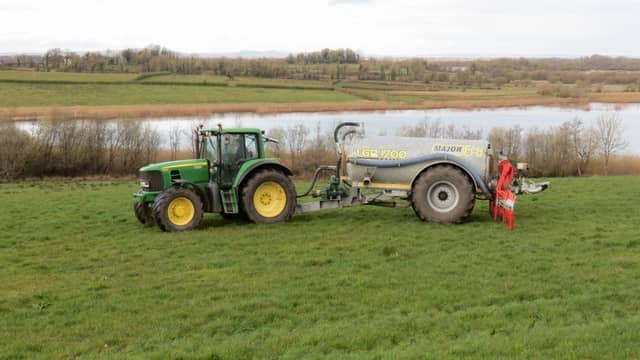

AS the slurry closed season comes to an end, NI Water are reminding farmers to ensure that they protect water resources when spreading slurry or manures this springtime. It is asking everyone to consider carefully before spreading slurry, or other organic manures, so that there is no risk of pollution to our watercourses.
AS the slurry closed season comes to an end, NI Water are reminding farmers to ensure that they protect water resources when spreading slurry or manures this springtime.
It is asking everyone to consider carefully before spreading slurry, or other organic manures, so that there is no risk of pollution to our watercourses.
"This is particularly important this year in light of the algae issues we have seen in many of our lakes in the past year," a spokesperson said.
- During February organic manures (including dirty water) must not be applied:
- Within 250m of a borehole used for public water supply
- Within 50m of a borehole, spring or well
- Within 30m of lakes
- Within 15m of a waterway other than lakes (reduced to 5m when using LESSE)
- On waterlogged soils, flooded land or land likely to flood
- On frozen ground or snow-covered ground
- If heavy rain is forecast in the next 48 hours
l On steep slopes (with an average incline of 20 per cent or more on grassland, 15 per cent or more on all other land)
Roy Taylor, NI Water catchment manager, said: “Care in timing and placement of slurry, manure and fertiliser is essential to minimise the potential for loss from land to water.
"Steep slopes and soils with impeded drainage are vulnerable to runoff and losses during rainfall events.
"A rainfall event lasting only a few hours can deliver a large proportion of the total annual loading of phosphorus to rivers and lakes.
“If slurry is spread on poor, very wet ground or during or just before wet weather conditions, it can run off the land; this results in valuable nutrients ending up in our watercourses.
"Removing this from our water is difficult and expensive to treat, in order to provide the high-quality drinking water we all expect.”
How you can help to improve water quality:
- Only spread slurry and fertilisers when conditions are suitable
- Use the DAERA online tools to calculate your farm’s Phosphorus balance and manure Nitrogen loading
- Check your farmyard for slurry run off and sources of pollution
- Prevent cattle access to rivers causing erosion, sediment loss and pollution
- Nutrient Management Planning – if available use your Soil Nutrient Health Scheme results and run off risk maps
- Minimise Phosphorus inputs – meet P crop requirements from manures. Each tonne of concentrate feed contains approximately 5kg of P
- Eliminate chemical P fertiliser. Save money and help the environment
Follow the Nutrients Action Programme to farm efficiently