

Talk to explore legacy of leading Strabane trade unionist
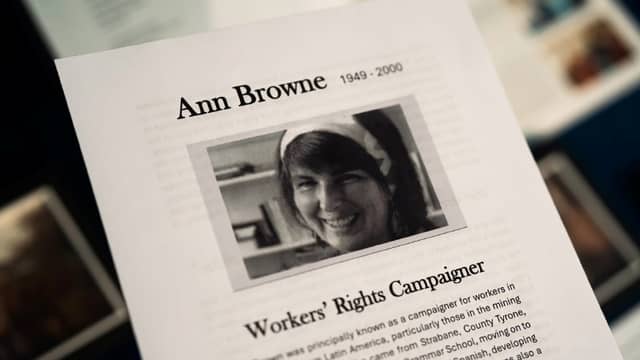

THE next meeting of Strabane History Society will focus on the life and work of Strabane's Ann Browne (1949-2000), a workers' rights campaigner and leading trade unionist in South America. An illustrated talk will be delivered by Alana Moore in The Music Rooms, John Wesley Street - off Railway Road - on Thursday, April 30 at 7.30pm.
THE next meeting of Strabane History Society will focus on the life and work of Strabane's Ann Browne (1949-2000), a workers' rights campaigner and leading trade unionist in South America.
An illustrated talk will be delivered by Alana Moore in The Music Rooms, John Wesley Street - off Railway Road - on Thursday, April 30 at 7.30pm.
Ann Browne was principally known as a campaigner for workers in and refugees from Latin America, particularly those in the mining and similar industries.
She came from Melmount Villas, Strabane, where she attended Mount Carmel Grammar School and Queen’s University, Belfast.
Here she studied Spanish, developing a great enthusiasm for the Latin American world.
She was also a strong supporter of the Northern Ireland Civil Rights movement which was at that time - the late 60s - a popular and powerful organisation.
After further studies at London’s Institute of Latin American Studies, where she was awarded her MA in 1974, she became a member of the Joint Working Group for Refugees from Latibn America (JWGRLA).
She was also active in the Chile Solidarity Campaign.
In 1977 she went for the first time to Latin America, in her role as co-ordinator of the JWGRLA on a trip with a delegation from the National Union of Mineworkers to Chile and Bolivia.
This experience awakened an interest in mineworkers and their working conditions.
Four years later she joined the miners’ International Federation (MIF), based in London and later Brussels, where she was education and organisation projects secretary, and when the MIF merged with the International Federation of Chemical, Energy, Mine and General Workers union (ICEM) she became projects officer with particular responsibility for Latin America.
Her main task in this role was to develop education programmes for trade unionists and miners’ wives.
Another one of her concerns was mineworkers’ safety in their unsafe workplaces, in which context she coined a slogan “the stronger the union, the safer the mine”.
She was viewed in many quarters as a militant, though this could cut both ways: after one visit to Peru a newspaper there (presumably not left leaning) described her as a “dangerous activist.”
She was certainly active: another of her interests was in the case of the mineworkers of Columbia where for years she was keenly supportive of the Trade Union
'Sintracarbon' (Sindicato Nacional de Trabajadores de la Industria del Carbon or National Syndicate of Coalworkers), based at the Correjon coalmining operation, the biggest in Columbia and one of the biggest in the world, in their campaign to secure better conditions including collective bargaining rights.
This was dangerous territory; as late as 2004 members of the European Parliament were still finding themselves condemning death threats and extortion attempts by members of paramilitary groups in Columbia against collective bargaining committee members of Sintracarbon, which had become one of the most effective trade unions in Latin America.
On her death from bone cancer tributes to her came from all over the world, mainly but by no means exclusively from trade union activists, refugees, their families, praising her courage, level headedness, good humour and commitment.
A History Society spokesperson said: "All welcome to the talk by Alana Moore on Thursday, April 30 at 7.30pm in Strabane Brass Band Clubrooms at John Wesley Street, off Railway Road.
"Last month we enjoyed a most interesting talk by Dr William Roulston on Lady Agnes Campbell and her influence on the development of early Strabane."
The spokesperson added: "Strabane History Society would like to thank Tommy Barr, Terry Doherty and Strabane Brass for hosting this illustrated talk."
Next month, the History Society will visit St Lugadius Church, Lifford and Donegal Museum in The Courthouse on Thursday, May 28, leaving John Wesley car park in Strabane at 7pm.