

Budding crafters try their hand at ancient art of crook-making
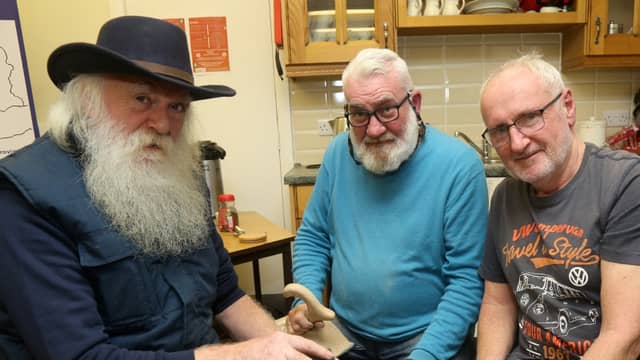

IN DAYS gone by, making a shepherd's crook was an essential skill for any rural-dweller, and carving them proved not only a necessity but an enjoyable past-time. However, in today's modern age, fewer and fewer people have the need for a shepherd's crook, and even fewer would be willing to spend months curing and carving their own stick.
IN DAYS gone by, making a shepherd's crook was an essential skill for any rural-dweller, and carving them proved not only a necessity but an enjoyable past-time.
However, in today's modern age, fewer and fewer people have the need for a shepherd's crook, and even fewer would be willing to spend months curing and carving their own stick.
And besides, if the need arose, a few clicks on Amazon could see a crook or stick delivered the very next day.
Such is the age of instant gratification, where old skills and trades that our ancestors once depended on, are fast-being eroded.
But in what is a heartening juxtaposition, it appears that local interest in the ancient art of crook making is once again growing!
Over the past four weeks, local people have been gathering together at Glenelly House, tools in hand, to sculpt their very own shepherd's crooks and 'shortsticks'.
No Internet, no 'Youtube' tutorials - just sharpened 'rasps', local knowledge, and an old yarn or two for good measure!
The four-week workshop made possible by the CARE Project and National Lottery Community Fund, has been a huge hit with crafters, who have been whittling, warping and whiling away the hours, under the expert guidance of the highly knowledgeable Tom Crowe.
The Castlederg man is certainly no stranger to the intricacies and techniques behind crooks and walking sticks.
A newcomer he is 'knot', and his skills stretch far beyond that of 'seasoned' crafter, as his carvings of wood, ram and buffalo horn have been exported worldwide, with some even finding homes at locations such as Balmoral Castle!
For Tom, the classes provided the chance to share his wide knowledge of what is becoming a fast-disappearing craft.
"The classes have been a great success, and everyone has really taken to the task of making their own crook or walking sticks," he said. "At the last class, I was showing people how to use a 'rasp' and sandpaper to shape the 'shanks', and people were intrigued and excited in equal measure.
"Everyone has been asking plenty of questions, and they are keen to learn as much as they can about the process.
“At the end of the four weeks, participants will be taking home their very own crook, which just needs to be varnished."
The process of making a shepherds crook or walking stick requires planning and patience in equal measure, much like any craft in the days before mass-produced products and instant information.
For the stick component itself, suitable lengths of wood must be first sourced, requiring a good eye, and then seasoned for around two years, before they can be used.
For the 'shank', which is the handle or 'crook' component, woods such as mahogany, oak or ash must also be seasoned before use, and cut in a particular way to ensure it doesn't split when being carved.
For the purposes of the class, Tom provided 'shanks' of oak ready seasoned and cut, with allowed participants to skip to the much-more interesting task of shaping.
Crooks can also be made from horn, with Jacob ram or buffalo horn being popular choices.
Again, preparation is key, and not all horns are created equal.
Suitable horns must be boiled to soften before being pressed, worked and shaped to form the traditional style of crook.
Interestingly, the colour variation often found in the Jacob breed's horn are preserved in the finished product.
While the process is complicated for the layman, for the likes of Tom it is second nature.
"I suppose you could say I am "experience", he laughed. "I have been at it a right while, we will leave it like that!
"I work with rams horn, buffalo horn, stuff like that, and I have sticks all over the world, and I wouldn't like to have to travel to where some of them are!
"I suppose I picked up the skill over the years. I always had an interest in it, from a young age. Every stick has it's own character, and it's about bringing the best out of it.
“It takes time, but when you arrive at something at the end, there is a great satisfaction."
And while crook and stick making is something of a niche trade in today's modern age, Tom said that in years gone by - when people dwelled in thatched cottages - crook-making would have been much more prevalent.
"A lot of shepherds back then would have made their own sticks, I am told," he said.
"In those days I suppose there was a lot less entertainment and a house, with only a hearth fire. There was electricity and more importantly, no Emmerdale!
"Those old shepherds would have shaped a rams horn over the winter time, and that would have been their stick for a while until it needed replaced. As well as making something practical for themselves, it was a pastime.
"The world has changed drastically since the olden days, so it's good to keep these old trades alive and impart this traditional knowledge onto others."
Speaking on the classes, Bronagh Kearney, of Glenelly House, said: "We are delighted to welcome renowned craftsman Tom Crowe back to Glenelly House for another four weeks of making a selection of walking sticks and shepherd's crooks.
" This is a unique and interesting workshop to host and is popular with many from the farming community.
"These classes are supported by the CARE Project which is funded by the National Lottery Community Support Fund for NI which has been made possible thanks to National Lottery Players."
For more information on the classes or the project please contact Bronagh Kearney at Glenelly House in Plumbridge on 028 816 48000.